

( ENSPIRE She Did That ) Phylicia Porter’s Baltimore Blueprint Redefines Community Wellness
Baltimore Councilwoman Phylicia Porter champions a unified “health on all levels” approach, reframing mental health as a citywide system of care rooted in equity, early intervention, and long-term community healing. In Baltimore, where the echoes of systemic inequities often intersect with everyday resilience, Mental Health Awareness Month is more than a date on the calendar; it’s a mirror held up to the city’s reality. And for City Councilwoman Phylicia Porter, it’s also a mandate.
Porter, who chairs the Baltimore City Council’s Public Health and Environment Committee, has been advancing a bold and deeply interconnected vision of wellness, one that refuses to isolate mental health from the conditions that shape it. Instead, she calls it what it is: health on all levels. This is not a slogan. It’s a strategy.

In Porter’s Baltimore, mental health is not confined to therapy rooms or crisis hotlines. It lives in classrooms where children carry unspoken trauma. It shows up in maternal wards where stress and inequity meet childbirth. It surfaces in neighborhoods still grappling with the ripple effects of the opioid crisis. Mental health, she argues, is everywhere, and so must be the solutions.
Mental Health Awareness Month becomes, through her lens, less about awareness and more about alignment: aligning systems that have long operated in silos, health care, education, addiction recovery, and maternal services, into something unified and responsive.
Baltimore’s opioid epidemic continues to cast a long shadow, and short-term fixes cannot address it alone. Porter has been active in shaping how the city thinks about recovery, not as a moment of intervention, but as a continuum of care. Her focus is sharp: transparency in funding, equity in service distribution, and accountability in outcomes.
Because in her view, it is not enough to expand treatment centers if access remains uneven. It is not enough to fund recovery programs if communities most impacted by addiction remain structurally underserved. Healing, she insists, must be designed to last.
If Baltimore’s future is to look different from its past, Porter believes it must start with children. In schools across the city, she has pushed for expanded health services that integrate behavioral and physical care directly into educational environments. The goal is simple but powerful: meet children where they already are. For students navigating trauma, instability, or anxiety, school-based care becomes more than support; it becomes safety. It becomes consistent in systems that too often feel unpredictable. Early intervention, Porter emphasizes, is not just prevention. It is a transformation.
For Porter, maternal health is where generations meet. The experience of pregnancy and childbirth in Baltimore, particularly for Black mothers, reflects broader inequities in access, stress, and outcomes. Porter’s work in this space centers on expanding coordinated care, where physical health, emotional wellness, and postpartum support are treated as inseparable.
Because maternal health is not a moment in time. It is the beginning of a ripple effect that shapes families, children, and communities. When mothers are supported holistically, she argues, entire ecosystems of care become stronger.
What ties Porter’s work together is not a single policy, but a philosophy. “Health on all levels” is her way of rejecting fragmentation in public health. It is a refusal to treat mental health as separate from addiction. A refusal to treat children’s wellness as separate from education. A refusal to treat maternal health as separate from emotional care. Instead, she pushes for a system where each layer reinforces the next. Where prevention is just as important as treatment. Where access is matched with accountability. Where equity is not an aspiration, but a design principle.
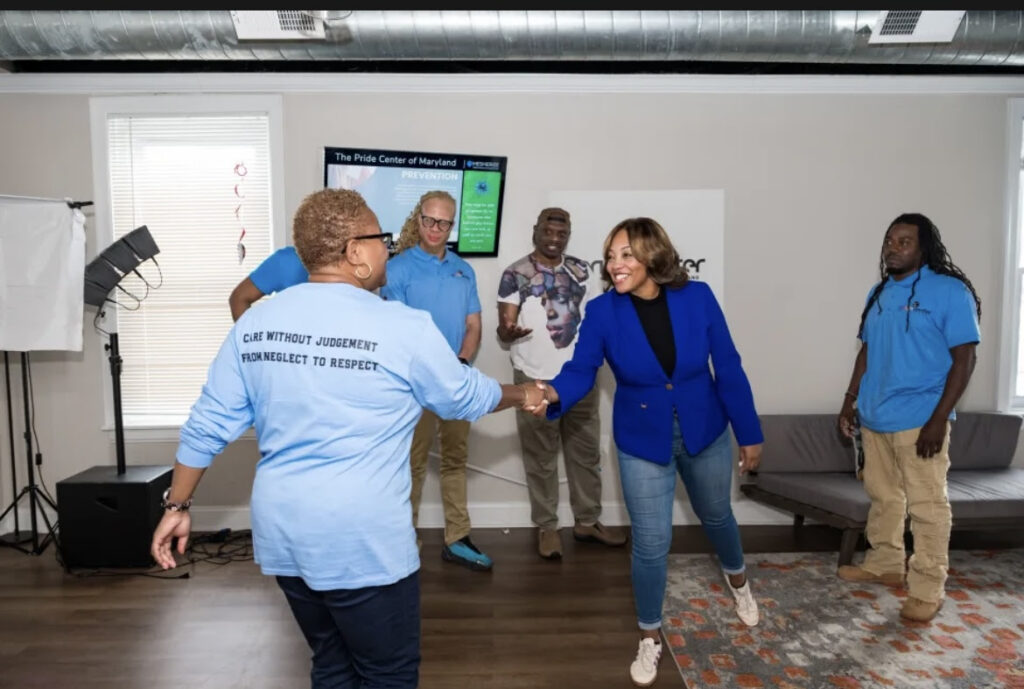
As Mental Health Awareness Month unfolds, Porter’s message extends beyond symbolic recognition. It challenges Baltimore, and any city facing similar struggles, to rethink what it means to build healthy communities. Because awareness alone does not fill gaps in care. And recognition alone does not heal trauma. What, in Porter’s vision, is integration? Systems that talk to each other. Policies that reflect lived experience. And a commitment to seeing health not as a single issue, but as a shared foundation.
In Baltimore, that foundation is still being built. But with leaders like Phylicia Porter shaping its direction, the blueprint is becoming clearer: healing happens when every level of health is finally seen as one.
Related Articles: Spoiled Brats Promotes Mental Health